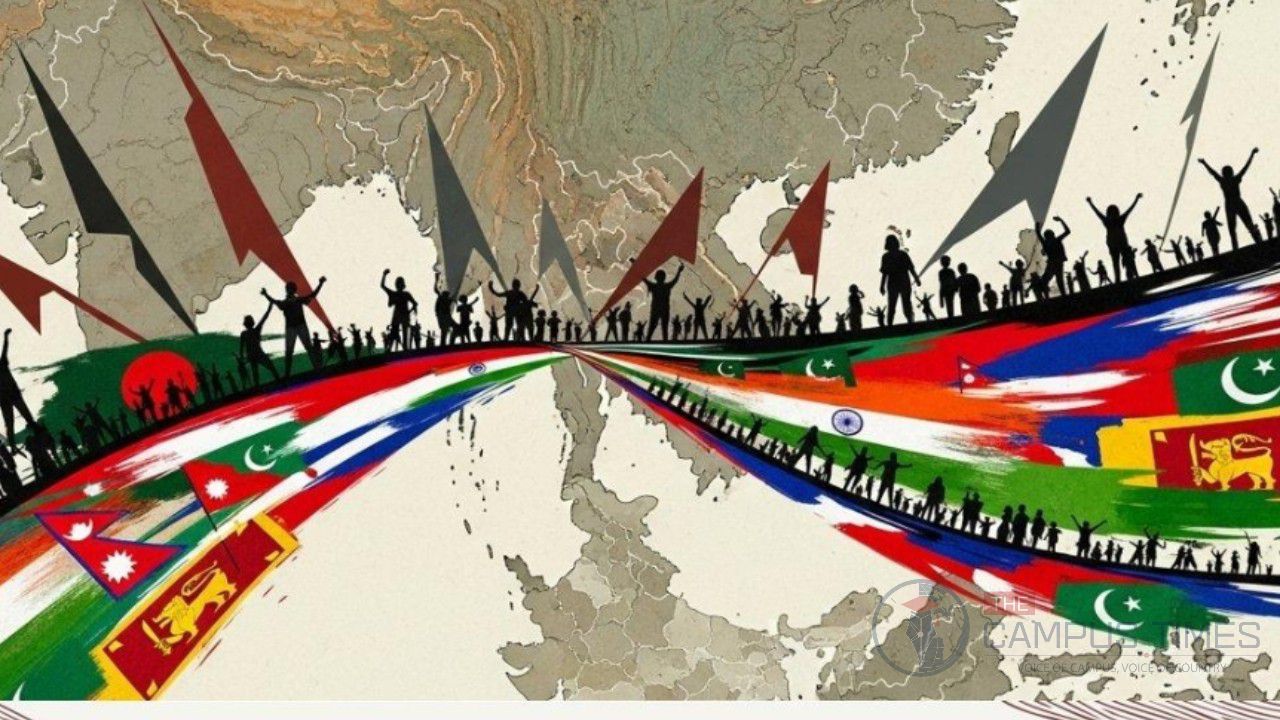
The New South Asian Spring
How student revolutions are redrawing the political map of South Asia Written by- Nayem Bin Rafique, Department of International Relations, University of Dhaka, Intern at Applied Democracy Lab (ADL)In New Delhi this July, a crowd that began as a joke has refused to go home. They call themselves the Cockroach Janta Party, a mocking nod to a ruling-party leader's jibe about the country's credential-hungry youth, and for more than a month they have camped at Jantar Mantar demanding the resignation of India's education minister. At the center sat Sonam Wangchuk, a 59-year-old engineer-turned-activist who fasted for 26 days until federal ministers came to negotiate. Tear gas has been fired; baton charges filmed on a thousand phones. A generation told to study hard and wait its turn has stopped waiting.Three years earlier, in Colombo, protesters occupied a seaside promenade, cooked communal meals for strangers, and eventually walked into the president's residence, swam in his pool, and posted the pictures online. A year after that, in Dhaka, a movement over civil service hiring quotas ended with a prime minister of fifteen years fleeing by helicopter as her palace was ransacked. A year after that, in Kathmandu, teenagers in school uniforms marched against a ban on Facebook and Instagram, watched parliament burn, and forced out a prime minister within twenty-four hours.Four countries. Four governments shaken or toppled. Four movements led not by opposition parties or unions but by students, gig workers, and those who had never voted for a government that gave them what it promised. The question now debated from foreign ministries to newsrooms is whether this is coincidence or a pattern: a South Asian Spring, echoing the wave that swept the Arab world in 2011. The honest answer is more interesting than either extreme. These are not one movement wearing four flags. But they are not strangers to each other, either.Sri Lanka's crisis had been building for years before it detonated in 2022. Debt-financed spending, a botched organic-farming experiment, the pandemic's collapse of tourism, and a sweeping tax cut had left reserves nearly empty. Sri Lankans queued for days for fuel and medicine as inflation topped 69 percent; some died in line. The protests they called the Aragalaya, "the struggle," began outside President Gotabaya Rajapaksa's residence and grew into an occupation nicknamed "GotaGoGama." Leaderless and cross-communal, its chant "Gota Go Home" became a global meme. His cabinet resigned in April; his brother, the prime minister, followed in May. On July 9, protesters stormed the presidential residence, and images of Sri Lankans lounging in the president's pool became symbols of revolt against dynastic power. Rajapaksa fled days later and resigned by email from Singapore. Parliament installed Ranil Wickremesinghe, a veteran with no popular mandate, who used the military to dismantle the camp within weeks and pursued IMF-backed austerity that stabilized the economy but punished the people who had filled the streets. The dynasty fell; the deeper reforms protesters demanded mostly did not follow.If Sri Lanka supplied the proof of concept, Bangladesh supplied the scale. What began in June 2024 as student anger over a quota reserving government jobs for veterans' descendants escalated once Prime Minister Sheikh Hasina's government met protest with force. Police and the ruling party's student wing clashed violently with demonstrators; a nationwide internet blackout meant to choke coordination instead confirmed the state's fear of its own citizens. The killing of student Abu Sayeed, shot with his arms outstretched, became a rallying symbol. By late July, in what Bangladeshis call the July Massacre, security forces killed protesters by the hundreds within days. On August 5, Hasina resigned and fled by helicopter to India moments before her residence was stormed, ending fifteen years in power. The health ministry later put the toll above a thousand the bloodiest stretch since 1971. Days later, an interim government was sworn in under Nobel laureate Muhammad Yunus, with former student organizers moving into government roles and eventually founding a party. A year on, the euphoria has frayed: the Awami League has been banned from politics pending trials, and activists describe watching their revolution being "sold" by factions now jostling to inherit it.Fourteen months after Hasina fled, it was Kathmandu's turn, triggered not by economics but by something more intimate to a generation that lives online: a government ban on the platforms it uses to speak to each other. On September 4, 2025, Nepal suspended twenty-six social media platforms, ostensibly over registration rules nobody believed. The ban landed atop chronic corruption, a recycled political class, and a youth exodus so severe that roughly two thousand young Nepalis leave daily for work abroad, grievances sharpened by a viral "Nepo Kids" campaign contrasting politicians' children with ordinary youth. On September 8, thousands of demonstrators, many uniformed teenagers with no party banners, marched on parliament; security forces opened fire in what became the deadliest single day of protest violence in Nepal's modern history. Enraged crowds returned the next day and burned parliament. Prime Minister K.P. Sharma Oli resigned within twenty-four hours; the ban was lifted, too late to matter. At least 76 died and more than 2,300 were injured. The establishment turned to Sushila Karki, a former chief justice, as interim prime minister, reportedly at protesters' suggestion, and elections this year produced Balendra Shah, a 35-year-old former rapper, as the country's youngest-ever prime minister. Even so, some who lost limbs in September now say the corruption and joblessness they fought remain largely unaddressed. Winning, it turns out, is not the same as governing.India's protests, still unfolding, resist the finality of the other three, no government has fallen, and it remains uncertain whether one will. The trigger was the cancellation of NEET-UG, India's medical school entrance exam, after its papers leaked; roughly two million students had sat it, and the annulment has been linked to a string of student suicides. What turned an exam scandal into the country's largest youth mobilization in over a decade was less the leak itself than what it confirmed for a generation entering a labor market that cannot absorb it: that the promise of merit rewarded is increasingly fiction. The movement crystallized in May around the Cockroach Janta Party, a satirical online persona founded by digital strategist Abhijeet Dipke that turned an insult into a badge of identity and, within days, a following in the millions. By June it was sustained street protest, joined by established student federations, demanding Education Minister Dharmendra Pradhan's resignation and exam reform. Its turning point came, as in Nepal, through sacrifice: Wangchuk's 26-day fast, ended only after negotiations he said were conducted "in view of possible violence in the country," drew professionals and opposition figures well beyond the student base. Police tear-gassed and baton-charged marchers; Wangchuk himself was at one point forcibly hospitalized. Modi broke weeks of silence only on July 23, promising "swift justice", a pledge that has yet to empty the camps. Unlike its neighbors, India's protests target a minister, not the prime minister, and its federal scale and the ruling party's deep organization are real differences from Kathmandu, Dhaka, or Colombo. What is continuous is the grievance itself: a young population, chronic joblessness among the credentialed, and a widening sense that institutions meant to reward merit instead reward connections.Laid side by side, the four episodes share a grammar even where outcomes diverge: youth-driven, largely leaderless mobilization; digital coordination that outran state censorship; visible elite impunity as backdrop; and a single act of state violence or sacrifice, a death, a fast, a shooting that swelled the ranks more than the original grievance ever could. Women were visibly prominent in all four. None of this proves direct contagion. Sri Lanka's trigger was a currency crisis, Bangladesh's a hiring quota, Nepal's a social media ban, India's an exam leak, each locally rooted, none a copy of the others. What each successive uprising did supply the next was proof of concept: evidence a government presumed untouchable could be forced to yield. That is a demonstration effect, not a chain of causation, and South Asia's varied constitutions and security forces make any single outcome hard to assume. Critics of the "Spring" label note the Arab uprisings it echoes were unified by shared language and satellite media in a way South Asia is not, and that borrowing a name whose run in Egypt, Syria, and Yemen ended badly imports an unearned inevitability into stories still being written.The streets of Colombo, Dhaka, Kathmandu, and New Delhi tell different stories, shaped by different economies and grievances. Whether historians ultimately call this the South Asian Spring or four distinct national reckonings, one thing is no longer contested: a politically conscious, digitally fluent generation has emerged that no longer quietly accepts the terms handed down by the governments before it. Some of these movements have already toppled the leaders they set out to remove. India's remains unresolved. What is unmistakable, from Colombo's emptied presidential pool to the tents still standing at Jantar Mantar, is that South Asia's youth have become a political force its governments can no longer afford to ignore.